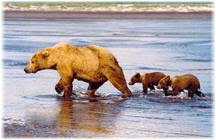
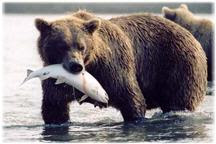
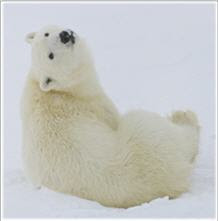
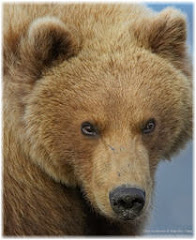
As with brown bears, black bears spend the winter months
in a state of hibernation. Their body temperatures drop,
their metabolic rate is reduced, and they sleep for long
periods. Bears enter this dormancy period in the fall,
after most food items become hard to find. They emerge in
the spring when food is again available.
Occasionally, in
the more southern ranges, bears will emerge from their
dens during winter. In the northern part of their range,
bears may be dormant for as long as seven to eight months.
Females with cubs usually emerge later than lone bears.
Dens may be found from sea level to alpine areas. They may
be located in rock cavities, hollow trees, self-made
excavations, even on the ground.
Friday, May 30, 2014
Thursday, May 29, 2014
Wolves
Wolves run on their toes, which helps them to stop and turn
quickly and to prevent their paw pads from wearing down.
Under certain conditions, wolves can hear as far as six miles away in the forest and ten miles on the open tundra.
A wolf pup’s eyes are blue at birth. Their eyes turn yellow by the time they are eight months old.
Wolves have about 200 million scent cells. Humans have only about 5 million. Wolves can smell other animals more than one mile (1.6 kilometers) away.
Under certain conditions, wolves can hear as far as six miles away in the forest and ten miles on the open tundra.
A wolf pup’s eyes are blue at birth. Their eyes turn yellow by the time they are eight months old.
Wolves have about 200 million scent cells. Humans have only about 5 million. Wolves can smell other animals more than one mile (1.6 kilometers) away.
Tuesday, May 27, 2014
Sandhill Cranes
Omnivorous ground feeders, cranes eat frogs, rodents,
insects, bulbs, seeds, and berries as well as occasional
seashore delicacies. They have adapted well to agriculture
and during the winter and on migration, feed largely on
waste grain and small animals associated with farm fields.
The dance of the sandhills may be one of the strangest breeding displays on the tundra. Often called a mating dance, display activity reaches a peak in late winter and early spring, but it has also been seen at other times of the year when two cranes meet. The ritual starts with a deep bow followed by great leaps, hops, skips, turns, and more bows. This dance can go on for many minutes.
Monday, May 26, 2014
Sunday, May 25, 2014
Bear Facts
- Because a giant panda’s eye is a vertical slit, like many nocturnal animals it can see by day and by night.
- Once bears breed, they go their separate ways. Male bears do not help the mother bear raise the cubs.
- When U.S. President Theodore (Teddy) Roosevelt refused to shoot a black bear cub on a hunting trip, a cartoon featured the event, and soon stuffed toy manufacturers popularized “Teddy’s bear.”
- Only about 1,000 giant pandas live in the wild today.
- The lips of bears are not attached to their gums, which make their lips look rubbery.
Saturday, May 24, 2014
Friday, May 23, 2014
Black-capped chickadee
The black-capped chickadee is found in deciduous and
mixed forests, open woods, willow thickets, cottonwood
groves, parks and disturbed areas.
The chickadee generally remains within its breeding range throughout the year but periodically disperses during fall and winter. Flocks of six to 12 chickadees roam over winter feeding ranges of about 40 acres, regularly visiting known food sites. They normally return each evening to roost among a particular patch of trees though some find shelter in cavities, under the eaves of houses or other protected sites. The birds may migrate short distances.
Thursday, May 22, 2014
Wolves
- Britain’s King Edgar imposed an annual tax of 300 wolf skins on Wales. The Welsh wolf population was quickly exterminated.
- In 1500, the last wolf was killed in England. In 1770, Ireland’s last wolf was killed. In 1772, Denmark’s last wolf was killed.
- After hearing of “frightening spirits” in the woods with human features that walked on four legs, Reverend Singh in 1920 discovered a den with two cubs and two human girls, one around age 7 or 8, the other around 2. After being brought back to “civilization,” the younger one died within a year. Recently, authors have questioned the validity of this story as modern knowledge has revealed that wolf-like behavior is often seen in autistic or abused children.
- Sextus Placitus, in his fifth-century B.C. Medicina de quadrupedibus (Medicinals from Animals), claims that sleeping with a wolf’s head under one’s pillow would cure insomnia.
- In 1934, Germany became the first nation in modern times to place the wolf under protection. Influenced by Friedrich Nietzsche’s (1844-1900) and Oswald Spengler’s (1880-1936) belief that natural predators possessed more vigor and virility than their prey, the protection was probably more for an “iconic” wolf than the actual wolf, particularly since the last wolves in Germany were killed in the middle of the nineteenth century.
- Unlike other animals, wolves have a variety of distinctive facial expressions they use to communicate and maintain pack unity.
- The Japanese word for wolf means “great god.”
Wednesday, May 21, 2014
Beaver
After mating (which takes place in January or February),
the female prepares for a new litter. Two to four kits on
average are born anytime from late April to June. Their
eyes are open at birth and the kits are covered with soft
fur. They can swim at 4 days and dive at 2 months of age.
The young beavers live with their parents until they are 2
years old. Then they leave to find their own homes.
To survive, beavers must be assured of 2 or 3 feet (0.6–0.9 m) of water year-round. Water provides a refuge from enemies and a way to float and transport heavy objects such as branches and logs for food and construction. Food for winter use must be stored in underwater food caches during autumn.
Tuesday, May 20, 2014
Alaska Vole
Northern red-backed voles can breed up to four times per
year. Young are born May-September and probably average
two litters per year. Litter sizes are between four to
nine, and average about six. About 20 percent of females
from the first litter breed during the summer of their
birth; the remaining 80 percent and later litters breed
the following May.
Gestation is 17–19 days. Young are weaned in 12–17 days and are mature in two to four months. Little is known about their reproduction strategy in the wild, but voles have displayed a polygynous mating system in captivity.
Monday, May 19, 2014
Sunday, May 18, 2014
Subscribe to:
Posts (Atom)

.jpg)
.jpg)

.jpg)
.jpg)
.jpg)
.jpg)
.jpg)
.jpg)

.jpg)

.jpg)
.jpg)
.jpg)
.jpg)
.jpg)

+(Small).jpg)