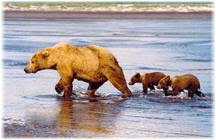
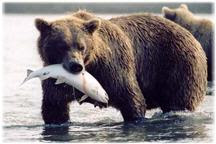
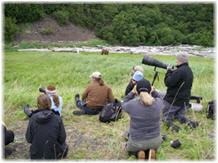
A Great Trip Needs An Extraordinary Destination ...Hallo Bay? ABSOLUTELY

Friday, March 7, 2014

Fun Bird Facts

According to National Geographic, scientists have an answer for the age old dispute over which came first, the chicken or the egg.  Reptiles were laying eggs thousands of years before chickens appeared.  The first chicken came from an egg laid by a bird that was not quite a chicken.  Therefore, the egg came first.
The first bird domesticated by humans was the goose.
Kiwi birds are blind, so they hunt by smell.
Some breeds of chickens can lay colored eggs. The Ameraucana and Araucana can lay green or blue eggs.
The common phrase "eat like a bird" should mean something quite different!  Many birds eat twice their weight in food each day.  In fact, a bird requires more food in proportion to its size than a baby or a cat.
A group of larks is called an exaltation, a group of chickens is called a peep, a group of geese is called a gaggle, a group of ravens is called a murder, and a group of owls is called a parliament.
Chickens that lay brown eggs have red ear lobes. There is a genetic link between the two.
Crows have the largest cerebral hemispheres (brains), relative to body size, of any avian family.
Mockingbirds can imitate many sounds, from a squeaking door to a cat meowing.


Wednesday, March 5, 2014

Harbor Seals

Harbor seals (Phoca vitulina), are “true seals” of the Phocidae family, also sometimes called “common” or “hair” seals. They are covered with short, stiff, bristle-like hair. Coloration varies, but two basic patterns occur: light gray sides and belly with dark blotches or spots, or a dark background with light rings. They can be distinguished from other pinnipeds, such as fur seals and sea lions, by the absence of external ear flaps; only a small hole (the external pinnae, or opening to the ear canal) is visible on either side of their head.

When on land, harbor seals move awkwardly by undulating in a caterpillar-like motion because their pelvic bones are fused, preventing them from moving their hind flippers under their pelvis to walk. In the water they are graceful and efficient swimmers, using their fore flippers as rudders and their hind flippers for propulsion by clasping both hind flippers together, splaying webbed toes and moving the large hind flippers side to side.
Harbor seals weigh about 24 pounds (11 kg) at birth and gain weight rapidly during a month-long suckling period; perhaps doubling their weight. They can reach five to six feet (1.5-1.8 meters) in length. Average weight for adults is about 180 pounds (82 kg); males are somewhat larger than females and can weigh up to 285 pounds (129 kg).

Tuesday, March 4, 2014

Bear Legends


The 3 Braves

Long ago, the Great Bear wandered freely throughout the sky. His massive paws took him far across the boundless ceiling of the world. He hunted and fished, feeding there in the rivers of the sky. All throughout the first spring he did this, until his belly was full and he was happy.

Little did he know that three braves had discovered him feeding that spring and they sought his meat and pelt to feed their families in the long winter that they knew was coming.
Without warning, the braves ran out after the bear. The Great Bear took off running, trying to escape from the hunters. All through the long summer he ran, trying to get away. The braves, however, were very cunning and strong. It was in the first autumn when their arrows pierced the Great Bear and he died.
The blood of the bear spilled out of the sky and tinged all of the leaves with red and orange. The trees then dropped all of their leaves in mourning for their friend.
The Great Bear was reborn the following spring as is the way of bears, and the braves set out after him again. They do this each year. If you look into the sky and watch, you can see the three braves trailing behind the Great Bear as he runs from them towards the horizon, only to do it again with the coming of spring.

These legends are but a few of the many that explain the reasons for those constellations. It is worth the time to go out and look at them, however. Even if you are not one who is interested in astronomy, it is a nice to be able to go outside and watch the bears in the sky.


Monday, March 3, 2014

Bald Eagles

The bald eagle is named for the conspicuous white head of the adult bird. It was named by American colonists at a time when bald (or ‘balled’) meant white, not hairless. It takes about five years for the distinctive white plumage of both head and tail to gradually develop. Immature bald eagles are a mottled brown and white, and the young birds have a black beak as opposed to the adult’s yellow beak. As with many raptors, females are larger than males.

The bald eagle is Alaska’s largest resident bird of prey with a wing span of up to 7.5 feet (2.3 m) and weight between 8 to 14 pounds (3.6 – 6.4 kg).

Found only in North America, bald eagles are more abundant in Alaska than anywhere else in the United States. The Alaska population is estimated at 30,000 birds.

These magnificent birds, recognized for their biological importance as scavengers and predators in the natural world, are much admired for their beauty. A national emblem of the United States since 1782, they have been a spiritual symbol for Alaska Natives far longer than that.

Sunday, March 2, 2014

Bear Facts

  1. A male bear is called a boar or a he-bear. A female bear is called a sow or a she-bear. A group of bears is called a sleuth or sloth.
  2. The word “bear” is an Old English word, derived from the Proto-Indo-European *bher-, meaning “bright brown.”
  3. The symbol of the United Russia Party is a bear. In fact, bears have traditionally not only been a symbol of pride and power in Russia, but have also been common images in fairy tales and myth.
  4. The Ursa Major or “Great Bear” constellation is the third-largest constellation and contains the Big Dipper.
  5. The bear ancestor is an offshoot of the ancient Canidae family of dogs, wolves, foxes, and coyotes.
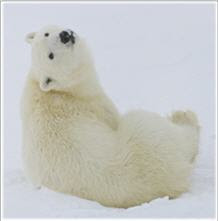
  6. The polar bear (Ursus maritimus) is the largest bear species. A male polar bear can measure up to 10 feet long and weigh 1,500 lbs., which is about the weight of eight human adults. Female polar bears are up to 50% smaller than the males.
  7. Polar bears are the only bear species that is a marine mammal.
  8. A polar bear’s fur ranges in color from ivory to pale tan. Underneath its fur coat, the polar bear’s skin is black to help absorb heat from the sun.
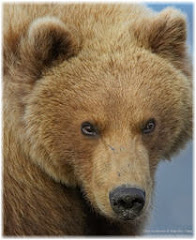
  9. The name “grizzly bear” refers to the silver-tipped or “grizzled” hair of a brown bear.

Thursday, February 27, 2014

See You At The Movies

Coming to Theaters
April 18th

A large part of the movie was filmed with us at Hallo Bay.
Come see us soon.

Wednesday, February 26, 2014

Fox

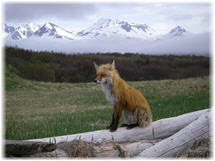
Red foxes are members of the dog family Canidae, and their general appearance is similar to dogs, wolves, and coyotes. The European red fox is the same species as the American red fox. The red fox measures 22 to 32 inches (56–82 cm) in head and body length, and the tail is 14 inches to 16 inches (35–43 cm) long. The adult fox weigh from six to 15 pounds (2.7–6.8 kg), but it appears heavier than it actually is. The males, or “dogs,” are usually heavier than the females, or “vixens.”

The red fox is usually recognized by its reddish coat, its white-tipped tail, and black “stockings,” although the species does have many color variations. The outside of the ears may be black-tipped, while the inside is usually white. The white tip on the tail will distinguish this fox from other species, regardless of its color phase. Red is the most common color, but the hair may be from light yellowish to deep auburn red. Several color phases can occur in one litter. Red foxes displaying a distinct color pattern are referred by the name of that phase (i.e., red, cross, silver, black). The cross fox, for example, has a black/brown cross on the back and shoulders. The silver and black phases are similar. However, the black does not have the silver-tipped guard hairs characteristic of the silver fox. The occurrence of black-silver phase appears to increase toward the north and the northwest of Alaska. However, even where most abundant, it comprises less than two percent of the population.

Sunday, February 23, 2014

Ptarmigan

Driven by their reproductive urge, males become less and less tolerant of each other throughout March and April. In early spring, males stake claims to parcels of ground that they defend in good weather, but spring snowstorms will send these males back into flocks. By late April or early May, males establish permanent territories that they defend in fair weather or foul. Hens arrive on the breeding grounds a bit later than males and then select their mates and nesting areas (often the same ones used the previous year). Males usually remain monogamous within a breeding season. By late May the first eggs are laid under a shrub at the edge of an opening. The males stay on their territories throughout June, although the intense strutting, tailfanning and aerial chasing typical of the courtship period wanes after the hens begin to incubate their clutch for about three weeks, which averages between six to ten eggs. Most Alaskan ptarmigan chicks hatch in late June and early July.

Unlike other North American grouse or ptarmigan, male willow ptarmigan usually help to care for their chicks. Sometimes, in fact, males will take over all family responsibilities if the hen is killed. Both adult willow ptarmigan are vigorous in their defense of the brood. One of the thrills in store for the Alaskan traveler is the chance to watch the excited actions of a female ptarmigan as she tries to distract attention from her chicks by simulating injury or to duck the flailing wings of the male as he dives at the two-legged intruder, cackling gutturally as he flies.

Saturday, February 22, 2014

Bear Facts

Bear Facts
  1. A polar bear’s stomach can hold 150 lbs. (68 kg) of meat.
  2. Panda bears have an extra “thumb” (which is actually an extra-large wrist bone) just for holding onto bamboo stalks. A panda bear can eat over 45 lbs. (20.4 kg) of bamboo per day.
  3. The giant panda has a large head for its body. Scientists believe this is because it needs a strong jaw and neck muscles to eat bamboo, which makes up 99% of its diet. The remaining 1% consists of insects on the bamboo and dead meat that the panda may find.
  4. Sloth bears’ favorite food is termites. These bears have no front teeth, so they easily suck out insects from their nests like a vacuum cleaner. They can also seal their nostrils for better suction.
  5. Bears have been known to eat almost anything, including snowmobile seats, engine oil, and rubber boots.
  6. Lumber companies felt they had no choice but to kill the black bears in Washington State that were eating the bark from trees. However, once someone thought to put piles of food in the forest, the bears stopped eating the trees, and were happy to eat the free food. Because feeding the bears cost less than killing them, the lumber companies were happy, too.
  7. About 98% of the grizzly bear population in the U.S. lives in Alaska.
  8. A polar bear can swim up to 100 miles without resting.
  9. Bears can see almost as well as humans, and they can hear a little better. But they can smell much better. In fact, a bear’s sense of smell is around 100 times greater than a human’s. Polar bears can track down an odor from 20 miles (32 km) away. They can smell a dead seal under 3 feet of solid ice.
  10. In 2004, a black bear was found unconscious in a campground in Seattle, Washington. It had broken into a cooler and used its claws and teeth to open dozens of beer cans. Although it sampled other types of beer, it chose to drink all the cans of only one type of beer. After its drinking binge, the bear passed out.